Manganese Deficiency Symptoms
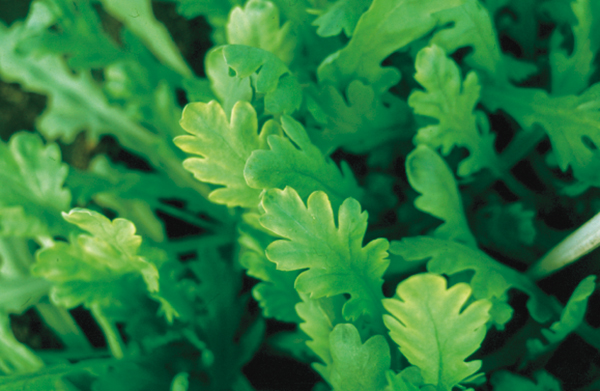
This is a true story that occurred in Hyogo Prefecture. In an area of Kobe City’s Nishi Ward known for the cultivation of tender leafy vegetables, many farmers began to experience yellowing of garland chrysanthemum (shungiku) leaves, a condition commonly known as “framing disorder.” Due to nearby land improvement projects, the farmers’ fields were relatively new, and most of them were well aware of the importance of compost, each having established their own compost storage facilities on their land. Since the region is close to the production area of Kobe beef, cattle manure was readily available. The farmers were also well informed about the harmful effects of applying fresh cattle manure compost directly to vegetables, so they produced fully matured compost themselves. Confident in the quality of their compost, they applied it two to three times a year during the growing seasons of tender vegetables, which allowed for as many as nine harvests annually. For about three years after the land improvement, production went smoothly. However, after that, “framing disorder” began to spread widely among many farmers.
This region is a major peri-urban agricultural production area, so the agricultural experiment station naturally assigned staff members and soil and fertilizer specialists to investigate. Although the responsible personnel were replaced every two to three years, even after seven or eight years of research, the cause could not be identified. However, once Mr. Kosuke Nagai, a specialist in food processing with strong skills in chemical analysis, took charge, he diagnosed the problem as manganese (Mn) deficiency within about two months, and found that foliar spraying of manganese could prevent the occurrence of symptoms. Because he was not a soil and fertilizer specialist, he did not cling to conventional soil analysis results from his own field, and this turned out to be beneficial. When soil and fertilizer experts collect soil samples in the field, bring them back to the laboratory, air-dry and finely grind them for analysis, the microorganisms containing manganese that were present in fresh soil die, and large amounts of manganese are released. The reason the cause had remained unknown for so long was that these artificially altered values were treated as standard analytical results. Professor Koiwai, a leading figure in organic agriculture and proponent of the BLOF theory introduced in Chapter 1, Section 6, employs fresh-soil analysis methods.
Dr. Marschner, whom we plant nutrition scientists greatly respect, has proposed that plants suffering from manganese deficiency contain higher levels of linoleic acid, which is unfavorable for human healthy longevity. Manganese deficiency occurs as a result of excessive compost application. The importance of dietary oils is discussed in detail by Professor Harumi Okuyama, the first president of the Japan Society for Lipid Nutrition. Readers are encouraged to study his work carefully.
The Three-Nutrient Test and Compost Application
Although practices may vary slightly among prefectures, most agricultural experiment stations in Japan are similar in this respect. In Hyogo Prefecture, since 1951 (Showa 26), continuous three-nutrient trials have been conducted on rice and wheat in a double-cropping system, with and without compost application. I joined the former Hyogo Prefectural Agricultural Experiment Station in 1968 (Showa 43), by which time the experiment had already been underway for 17 years.
As shown in Figure 1 (page 136) in the main text, differences in growth among the plots were small in paddy rice cultivation. However, in wheat cultivation (Figure 2, page 138), growth in the no-compost plots was markedly reduced. Can readers understand why this is the case? I recall that when I was a newcomer, a senior researcher told me, “This is a very good learning opportunity,” and encouraged me to think through the reason myself.
Let me explain. In paddy rice cultivation, there is almost no difference in growth even under continuous cropping. This is because flooding the fields keeps the soil pH nearly neutral. In contrast, in upland farming, there is a fertilizer-related concept known as “physiologically acidic fertilizers,” with ammonium sulfate being a typical example. In upland fields, ammonium nitrogen is converted into nitrate by nitrifying bacteria, and the sulfate in ammonium sulfate is itself acidic. This process is a major cause of soil acidification in upland farming.
Potassium chloride (KCl) also contributes to acidification: while plants absorb potassium ions (K⁺), hydrochloric acid (HCl) remains in the soil, making it more acidic. Because fertilizers cause soil acidification in upland farming, the application of lime is essential. The three-nutrient test teaches beginners such critically important facts.
Another important point is the effect of compost. Even within the same phosphorus-deficient plots, plant growth differs greatly depending on whether compost is applied. The answer to this question is actually explained in Chapter 1, Section 10, so please look forward to reading it.
Related Posts to New Common Knowledge About Nutrients

Health Benefits of Nitrate Ions/Correcting Zinc Deficiency

Boron Is Essential for Both Plants and Animals / Silicic Acid Is a Valuable Substance