Note: Chapter 2 is a revised and expanded version of articles published in the magazine Noko to Engei (Agriculture and Horticulture) from the September 2022 issue to the June 2024 issue, with the addition of ten new manuscripts.
Prologue
I received a request from the editor-in-chief of the quarterly magazine Noko to Engei, published by Seibundo Shinkosha, to write a serialized feature article titled “Aim for Higher Yield and Quality! Kazuhiko Watanabe’s Master Farmers’ Fields Reports” I began writing this series in the Autumn 2022 issue. I am not so presumptuous as to include my own name in the title; this was the title given to me by the editor-in-chief. Since this was a theme I had long hoped to write about, I immediately replied, “I don’t need any travel expenses.” This was because I already had several farmers in mind whom I wished to visit, although an assistant was kindly provided during the interviews. Prior to receiving this request, I had already contributed two special feature articles on “biostimulants” while I was in the middle of my ongoing series “New Knowledge on Nutrients.” Moreover, I was asked to expand in greater detail one of those articles, “Foliar Application of CHO Using Ethanol,” which was then published separately in the Winter 2020 issue. I have placed that article at the beginning of Chapter 2 in this volume.
For the editor-in-chief as well, that article served as the impetus for launching this new serialized feature.
However, the series was discontinued when the magazine itself ceased publication with the Summer 2024 issue, which featured Mr. Takehisa Otani of Otani Farm. Although interviews had already been conducted, the tenth article, featuring Mr. Koji Nakata, could not be published. In addition, an article on Mr. Yoshiaki Iwao, Technical Advisor for Cultivation at JAHT Co., Ltd., who had demonstrated outstanding expertise in strawberry cultivation guidance, remained unfinished. I sincerely apologize for this oversight and, as an expression of my regret, I hereby list the company name and contact information below.
JAHT Co., Ltd.
9F Nippon Life Midosuji Building, 4-2-4 Minami-Senba, Chuo-ku, Osaka 542-0081, Japan
TEL: +81-6-6121-4300
Website: https://jaht.co.jp/
Giant, High-Quality Grape Production through Foliar Application of CHO Using Ethanol
A Discovery Driven by the Passion of a Fertilizer Merchant and His Farmer Customers
Mr. Kenji Nagahama of Nagahama Shoten Co., Ltd.
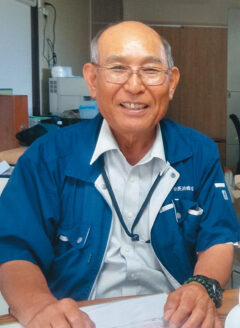
Photo 1: Mr. Kenji Nagahama of Nagahama Shoten
The main fertilizer discussed in this section was introduced in the special feature article on “Biostimulants” in the Autumn 2020 issue of Noko to Engei (Agriculture and Horticulture) (p. 56). It is a patented fertilizer called “NCV Coal,” patented in 2014 (Heisei 26), which can be used both as a soil amendment and as a foliar spray. It consists of ethanol containing plant oils and vitamins.
On July 23, 2020 (Reiwa 2), Mr. Kazuo Miura, President and CEO of San-yone Co., Ltd., a company that owns several food supermarkets in Aichi Prefecture and also operates a wholesale business in vegetables and fruits, visited my home with a friend. During our conversation, the topic turned to fertilizers from Nagahama Shoten Co., Ltd. (Toyohashi City, Aichi Prefecture). When I mentioned that I was already familiar with Nagahama Shoten, Mr. Miura told me that among the NCV Coal product line there is now a foliar spray called “VF Coal.” This fertilizer is made by adding humic and fulvic acids to ethanol, and according to Mr. Miura, using these two products in combination enhances their effectiveness. He said, “With these fertilizers, grapes and strawberries grow remarkably large and become exceptionally flavorful. You should definitely meet Mr. Kenji Nagahama, the father of the family that runs Nagahama Shoten. If there were 100 people like Mr. Nagahama, Japanese agriculture would be transformed.”
Visiting a Grape Grower Introduced by Mr. Nagahama
Mr. Miyagawa’s Vineyard
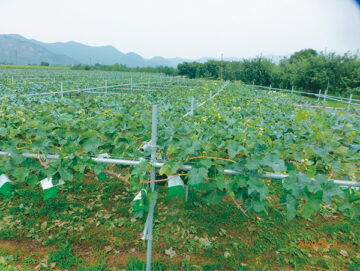
Photo 2: Mr. Miyagawa’s Vineyard
Accordingly, on July 28, 2020 (Reiwa 2), I visited Mr. Nagahama (Photo 1). Mr. Nagahama showed me various photographs of grapes, melons, strawberries, soybeans, wheat, and other crops produced by growers who were using a mixture of the two products, “NCV Coal” and “VF Coal.” What impressed me most was that the already large “Nagano Purple” grapes had become even more gigantic. It was not only grapes—strawberries, too, were of a size I had never seen before.
Unable to contain my excitement, I visited Mr. Takio Miyagawa, a grape grower in Nagano Prefecture, on August 9, 2020 (Reiwa 2), upon Mr. Nagahama’s introduction. Mr. Miyagawa manages approximately 3 hectares of vineyards and about 0.8 hectares of apple orchards, operated by seven family members and two hired workers. He remarked, “Sunlight is important, and it is also essential that some of it reaches the ground,” and first guided me through his carefully pruned vineyard (Photo 2). Harvesting begins in September, still two to three weeks away at the time, yet the grapes were already growing large and splendid. He measured the sugar content on the spot, and despite being three weeks before harvest, it already reached 19.4° Brix (Photos 3–5).
An Agricultural Operation that Nurtures Successors
It has been more than ten years since Mr. Miyagawa began cultivating crops using these fertilizers, and the grapes he produces have earned an excellent reputation in the market, providing him with a stable and sufficient income. His eldest son, Toshikazu, who had been working for an NTT-affiliated company, left his corporate job ten years ago and succeeded him as a fruit grower. His grandson, Taiki, graduated from the Nagano Prefectural College of Agriculture, worked on the family farm for one year, and then spent another year training at a produce wholesale market in Aichi Prefecture. During that time, he met Aya, who would become his lifelong partner, and returned home with her (unfortunately, their wedding ceremony had to be postponed due to COVID-19). He now helps with the family orchard, much to the delight of his parents. The fact that young people are so willing to take over the business demonstrates how smoothly and successfully the Miyagawa farm has been developing. Mr. Miyagawa expressed his deep gratitude, saying that this success is also thanks to Mr. Nagahama, who developed these innovative fertilizers.
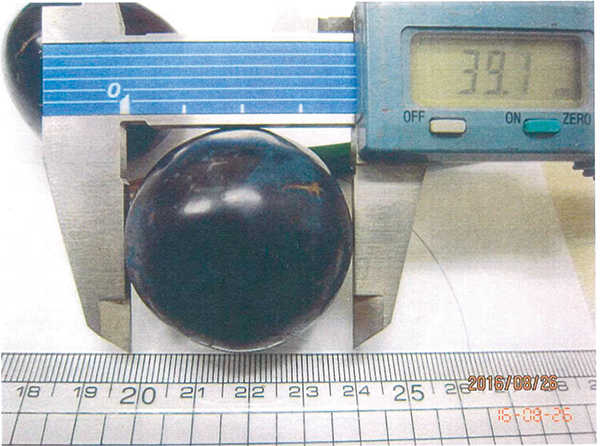
Photo 3
Mr. Miyagawa’s Nagano Purple Grapes
Diameter: 3.91 cm. Photographed in 2016 by Nagahama.
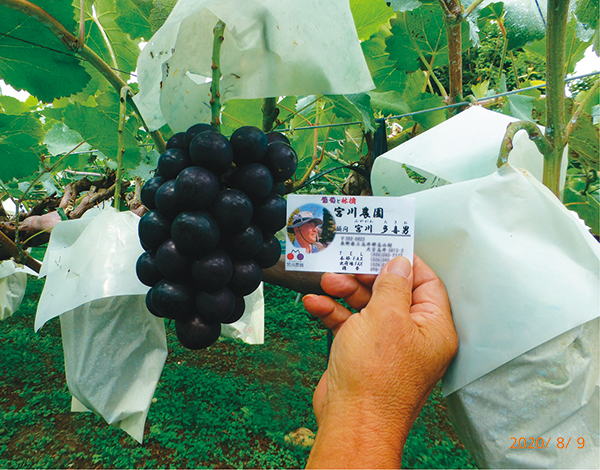
Photo 4
The remarkable size can be seen by comparing them with the business card placed beside them.
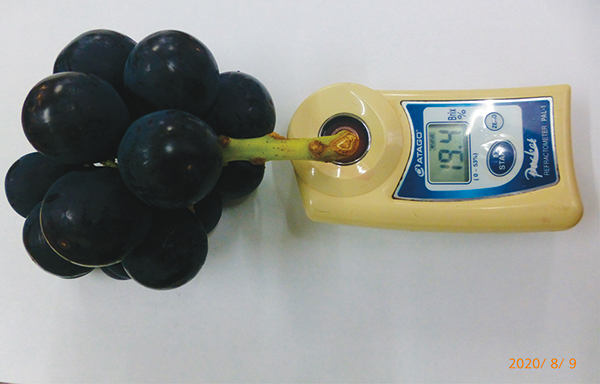
Photo 5
Sugar Content
Even three weeks before harvest, the sugar level measured 19.4° Brix.
“A Man’s Dream”: Bold Fertilization Practices
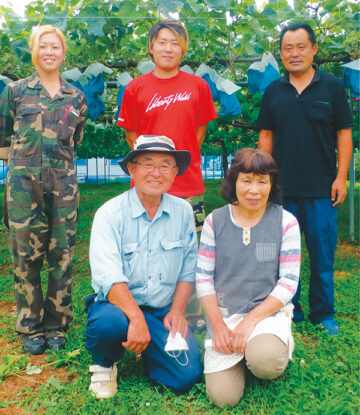
The Miyagawa Farm Family
Front row, from left: Mr. Takio Miyagawa and his wife, Ms. Misako Miyagawa.
Back row, from left: Ms. Aya, wife of grandson Taiki Miyagawa; Mr. Taiki Miyagawa; and their son, Mr. Toshikazu Miyagawa.
According to Mr. Nagahama, once Mr. Miyagawa becomes convinced that “this is good,” he applies the fertilizers more than twice as frequently as recommended by Mr. Nagahama. For example, during the grape-growing season, he carries out foliar applications twice a month—more than twelve times per year in total—using a mixed solution diluted 250-fold for “NCV Coal” and 200-fold for “VF Coal,” together with the necessary pesticides. Mr. Nagahama says that he never once claimed that foliar application would enlarge grape berries. The fact that Mr. Miyagawa’s grapes became larger, higher in sugar content, and richer in flavor is not due solely to the effects of these new fertilizers. Although Mr. Miyagawa calls this his “man’s dream,” he practices foliar spraying at more than twice the recommended frequency and invests an extraordinary amount in fertilizers—approximately 3 million yen for 3 hectares—far beyond what most growers would attempt. This is the pinnacle of cultivation techniques that he has finally achieved. No matter how high the quality of agricultural products may become, many producers would hesitate to use fertilizers to such an extent. Yet Mr. Miyagawa puts this bold approach into practice.
At present, I am not aware of any research that clearly explains why these fertilizers produce such remarkable effects when applied by foliar application. Future studies may well bring about a revolution in Japanese agriculture. I strongly hope for continued research and the widespread adoption of its results.
One very important point should be noted. Mr. Miyagawa’s annual fertilizer cost for 3 hectares amounts to about 3 million yen, an expense that few can emulate. However, for the past ten years, his annual income (profit) has reached 40 million yen. In recent years, he has further expanded his cultivated area, and his income is said to have increased even more.
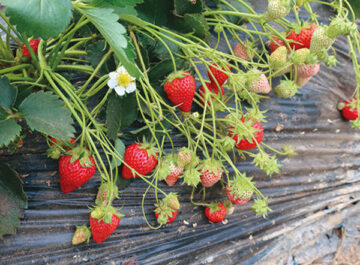
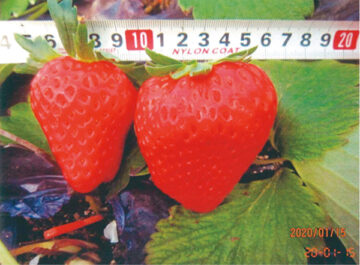
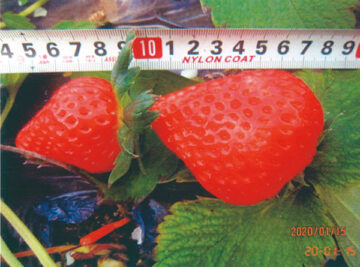
Photo 6: Strawberries grown by a farmer in Tochigi Prefecture, repeatedly treated with foliar applications of a mixed solution of “NCV Coal” and “VF Coal.”
Width: approx. 7 cm; Length: approx. 8 cm.
Photographed on January 15, 2020, by Nagahama.
Concerning Relevant Literature
Finally, for the benefit of future research, I would like to introduce several key references concerning foliar application.
In Micronutrients and Macronutrients by Yamazaki Tsutae (Hakuyusha, 1966), the book is divided into four sections: General Principles, Macronutrients, Micronutrients, and Countermeasures. In the section on countermeasures, “Foliar Application of Fertilizers” is further subdivided into (1) foliar application of macronutrients, (2) foliar application of micronutrients, and (3) concentrations for foliar application. Over eight pages, the author provides detailed descriptions of practical application rates for rice, vegetables, and fruit trees, as well as methods for preventing phytotoxicity. However, there is no discussion whatsoever of the foliar application of CHO (carbohydrates), which is the crucial point.
Regarding the site of absorption within the leaf, Outline of Plant Nutrition by Kumazawa Kikuo (Yokendo, 1974) presents a cross-sectional diagram of a leaf indicating that absorption occurs through ectodesmata*¹. The original source is cited at the end of the volume as:
W. Frank, “Mechanism of Foliar Penetration of Solutions,” Annual Review of Plant Physiology, 1967, 18: 281–300.
This is a comprehensive 40-page review article in English devoted to foliar application.
With regard to the foliar application of sugars, a detailed account can be found in The Green Alchemy by the Tsutsumi Shigeru (Seikosha, 1983), Professor Emeritus of Osaka University and Doctor of Science. Although Professor Tsutsumi graduated from the Department of Chemistry, Faculty of Science, The University of Tokyo, and originally wished to major in biology, he entered the chemistry department due to parental opposition. Nevertheless, he never abandoned his original aspiration. He later devoted himself to rose cultivation, pursuing it for forty years. He eventually established what he termed the “Foliar-Application-Only Cultivation Method,” in which spraying a mixture of fertilizer and glucose is recommended.
Mr. Nagahama once visited Professor Tsutsumi at his home, and since one of Professor Tsutsumi’s disciples lives nearby, Mr. Nagahama has also been influenced by his work to some extent. In addition, at the level of agricultural experiment stations, glucose foliar application trials were once conducted in various regions, but most of them ended in failure. I myself asked Mr. Kenichi Yoshida (now retired) of Hyponex Japan Co., Ltd. to conduct a glucose spraying test on potted gloxinia plants. However, perhaps because the concentration was slightly too high, the treatment actually accelerated senescence. We eagerly await new research findings.
¹ Ectodesmata: structures in leaf tissues such as stomata and hydathodes.
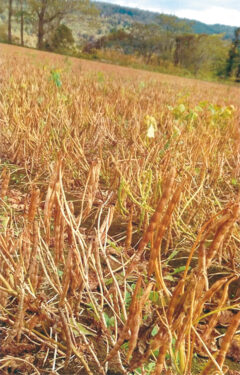
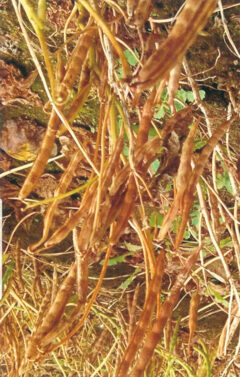
Photo 8: Soybeans in Hokkaido treated with foliar sprays of “NCV Coal” and “VF Coal” five to six times.
Normally, each pod contains about four beans, but in these plants, six—and sometimes even seven—beans per pod were observed.
Photographed in July 2019 by Nagahama.
Related Posts to Records of Master Farmers